
“`html
The Challenge of Modern Health Literacy
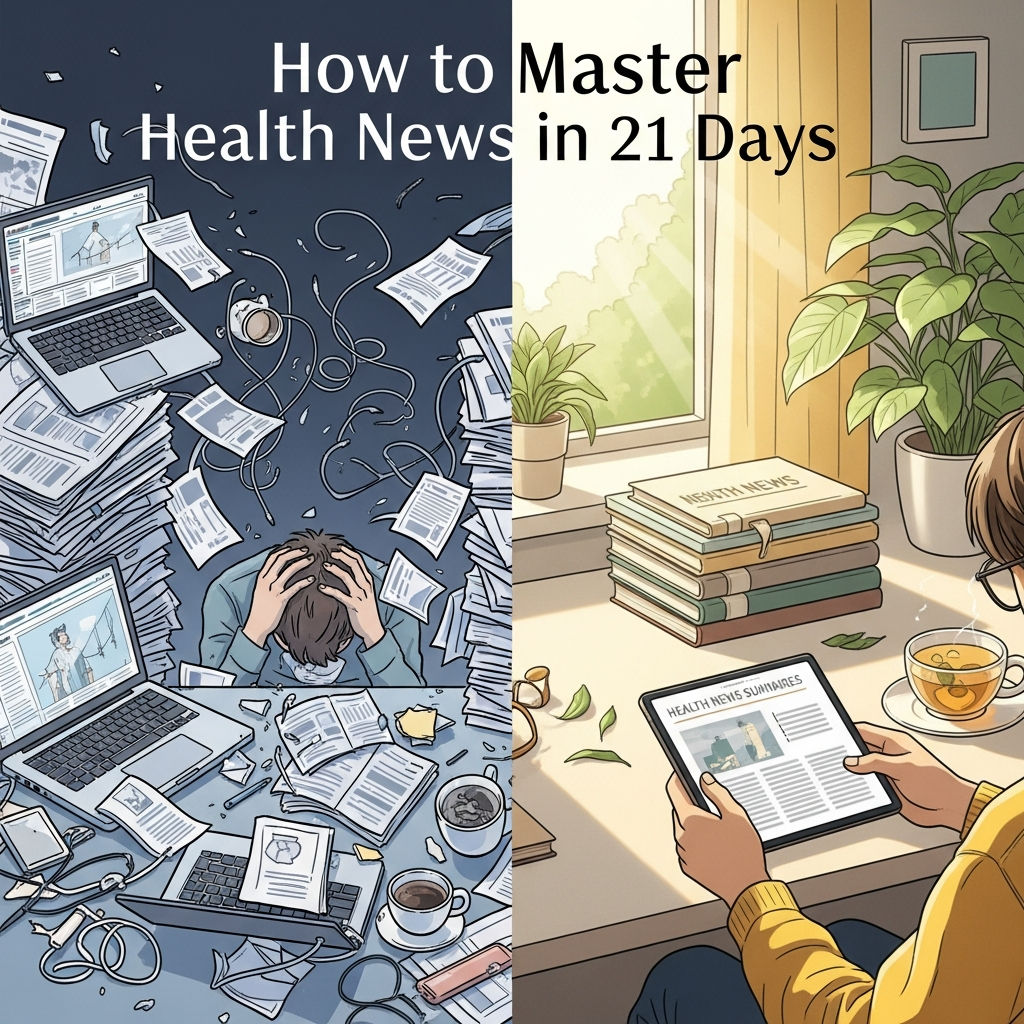
In an era of instant information, we are bombarded with health headlines every time we open a social media app or look at a news notification. One day, red wine is a miracle for heart health; the next, it is a significant risk factor. Sifting through the noise to find actionable, science-based information is no longer just a skill—it is a necessity for your well-being. Mastering health news allows you to make informed decisions about your diet, exercise, and medical treatments without falling prey to sensationalism or misinformation.
The good news is that health literacy is a muscle you can build. By following a structured 21-day plan, you can transform from a passive consumer of clickbait into a savvy navigator of medical data. Here is your roadmap to mastering health news in just three weeks.
Week 1: Building a Foundation of Credibility
The first seven days are dedicated to cleaning up your “information diet.” Just as you wouldn’t eat junk food and expect to be healthy, you cannot consume low-quality news and expect to be well-informed.
Day 1-3: Identify the “Gold Standard” Sources
Start by bookmarking websites that have high standards for peer review and institutional accountability. Focus on these three categories:
- Government Health Agencies: The Centers for Disease Control and Prevention (CDC), the National Institutes of Health (NIH), and the World Health Organization (WHO).
- Academic Institutions: Harvard Health, Mayo Clinic, and Johns Hopkins Medicine.
- Reputable Medical Journals: The Lancet, The New England Journal of Medicine (NEJM), and JAMA.
Day 4-5: Learn the CRAAP Test
Master the “CRAAP” method to evaluate any health article you encounter:
- Currency: How recent is the information? Medical science moves fast.
- Relevance: Does the information apply to your specific situation?
- Authority: Who wrote this? Are they a medical doctor or a PhD in a relevant field?
- Accuracy: Is the information supported by evidence? Are there citations?
- Purpose: Is the site trying to sell you a supplement or a program? If so, be wary.
Day 6-7: Audit Your Social Media Feed
Algorithms prioritize engagement over truth. Spend these two days unfollowing accounts that use “fear-mongering” language (e.g., “What doctors aren’t telling you”) or promise “miracle cures.” Replace them with verified medical professionals and science communicators who cite their sources.
Week 2: Decoding the Science Behind the Headlines
Now that you know where to look, you need to understand what you are looking at. Week two focuses on the “language” of health news.
Day 8-10: Correlation vs. Causation
This is the most common pitfall in health reporting. If a study says “People who drink tea live longer,” that is a correlation. It does not mean tea caused the longevity; tea drinkers might also have higher incomes or better exercise habits. Mastering health news requires recognizing when a headline is jumping to a causal conclusion that the data doesn’t support.
Day 11-12: The Hierarchy of Evidence
Not all studies are created equal. Understand the pyramid of evidence:
- Meta-analyses and Systematic Reviews: The strongest evidence, as they look at all available research on a topic.
- Randomized Controlled Trials (RCTs): The “gold standard” for testing a specific intervention.
- Observational Studies: Good for finding patterns but cannot prove cause and effect.
- Animal or In-Vitro Studies: Interesting, but rarely translate directly to human health. If a headline says “X Cures Cancer,” check if it was only tested in a petri dish.
Day 13-14: Understanding Absolute vs. Relative Risk
Health news often uses “relative risk” to make findings sound more dramatic. For example, “Eating X increases your risk of disease by 50%!” sounds terrifying. However, if the original risk was only 1 in 1,000, a 50% increase only brings it to 1.5 in 1,000. Always look for the absolute risk to keep things in perspective.
Week 3: Integration and Habit Formation
In the final week, you will turn your new skills into a sustainable routine that keeps you informed without causing “headline fatigue.”
Day 15-17: Master PubMed and Google Scholar
Stop relying on secondary news sites. Learn to use PubMed. When you see a shocking health claim, search for the study’s abstract directly. Reading the “Conclusion” or “Limitations” section of an abstract will often give you a much more nuanced view than a 500-word blog post.
Day 18-19: Curate Your Daily Briefing
Don’t let news find you; go find the news. Set up a dedicated RSS feed or subscribe to curated medical newsletters like “The JAMA Network” or “Stat News.” This ensures you are seeing a balanced overview of the medical landscape rather than just what is trending on Twitter.
Day 20: Practice Fact-Checking in Real-Time
Pick a trending health topic—perhaps a new diet or a workout trend. Use everything you’ve learned: check the source, find the original study, look for the sample size, and determine if the claims are based on correlation or causation. If you can debunk or confirm a story in 10 minutes, you have mastered the process.
Day 21: The Doctor Dialogue
The final step in mastering health news is knowing its limits. No matter how much you read, health news is general, whereas your health is personal. Use your final day to prepare a “Health News File” for your next doctor’s appointment. Learn to ask: “I read about this study; does this apply to my specific health profile?”
Common Pitfalls to Avoid
As you continue your journey beyond these 21 days, watch out for these common traps:
- Confirmation Bias: Only seeking out news that confirms what you already believe (e.g., searching for “benefits of Keto” instead of “pros and cons of Keto”).
- Single-Study Syndrome: Changing your entire lifestyle based on one new study. Science is a slow build of consensus, not a series of sudden “eureka” moments.
- Anecdotal Evidence: Valuing a testimonial (“It worked for my neighbor!”) over statistical data.
Conclusion: Knowledge is Power
By the end of these 21 days, you will have moved from a state of confusion to a state of clarity. Mastering health news doesn’t mean you have to be a doctor; it means you have to be a critical thinker. When you control how you consume health information, you take the first major step toward controlling your health outcomes.
Remember, the goal isn’t to know everything—it’s to have the tools to find out what is true. Keep questioning, keep verifying, and stay informed.
“`